Monday, 30 December 2019

VeChain Financial Executive Report Vol. 9 @vechainofficial #blockchain

Transparency, Fairness, Openness

With the aim of transparent communication on our achievements in creating tangible economic value, ...

Transparency, Fairness, Openness

With the aim of transparent communication on our achievements in creating tangible economic value, we are excited to present the ninth VeChain Foundation Financial Executive Report. This financial report covers a fruitful quarter from August 2019 through to October 2019.

On October 24th, Chinese President Xi Jinping announced the nation’s full embracement of blockchain technology, hailing it as “an important breakthrough for independent innovation of core technologies”. Enterprises and industry leaders around the world now have their focus on the adoption of blockchain technology in real working use-cases and applications, and as a result, VeChain has received even more interest and attention globally due to our unparalleled track record in enterprise adoption and blockchain applications focusing on real business value creation. It confirms our strategy of being an enabler and making blockchain technology as easy as possible for businesses to adopt.

As always, we sincerely welcome the community to hold us to the commitment of transparency, including but not limited to the rigorous monitoring and usage of our funds, and the development process of all aspects within the VeChain Foundation.

The report structure is as follows:

1. VET Supply Overview

2. VeChain Foundation Expenditure (use of proceeds)

3. Notes

i) Enterprise Investor Pool

ii) Co-Founders, Development Team

iii) The Operation, Technological Research and Development

iv) Business Development

v) Compliance & Legal

vi) Ecosystem Development

1. VET Supply Overview

At the end of October, the VET circulating supply was 63,439,279,106 which accounts for roughly 73.2% of the total supply, compared with 72.7% of last quarter end. Within the VET circulating supply, 22,161,653,627 VETs were in the soft-lockups, which makes about 25.6% of the total supply. It marked a 1.5% increase over the last quarter. In addition to the team lockup, we have seen X Nodes and Economic Nodes increase their holdings which signifies the continued long term confidence of the key stakeholders in the VeChain Ecosystem. By the end of this reporting period, around 47.6% of the VET total supply is free to trade on the open market.

Note:

* The soft-lockup categories are as follows:

  • Authority Masternode collateral — each Authority Masternode keeps at least 25 million VETs;
  • X Nodes staking — each X node keeps a minimum amount of VET based on four different tiers;
  • Economic Nodes staking — each economic node keeps a minimum amount of VET based on three different tiers;
  • Team Lockup — According to the whitepaper 5% of the total VET supply is allocated to co-founders and development team, and this pool is released quarterly over a two year period. However, in this reporting period the executive team as well as some of the team members voluntarily locked 356 million VETs, which is 69% of the total amount allocated to the team in this quarter. As of October 31, 2019, over 3 billion VETs have been locked up by the team to show the commitment to VeChain’s long term success.

** The ecosystem reserve was acquired through the VeChain Foundation Buyback initiative as of the end of October. This reserve will be used to facilitate the long term growth of the VeChain ecosystem. However, the Foundation BuyBack wallet was later involved in a theft in December 2019, more details regarding the ecosystem reserve will be disclosed in the next quarterly financial report.

2. VeChain Foundation Expenditure (use of proceeds)

We summarized below the USD value of the expenditure in fiat or BTC/ETH for the reporting period. For the spending in BTC or ETH, the USD value was booked based on the rate when the transaction occurred. In many situations our service providers and partners prefer to receive VET as direct payment or investment compared to using fiat or BTC/ETH. Therefore, the total expenditure for operation, technological and business development comprises a combination of direct VET payment and use of proceeds (fiat, BTC/ETH) depending on the associated parties’ preference.

3. Notes

i) Enterprise Investor Pool

During this reporting period, we continued evaluating the offerings on hand and are looking for institutional partners who could bring fundamental change, or value, to the long term development of the ecosystem. Around 30 million VETs were purchased from the enterprise investor pool. As always, the partners invested in this pool are subject to lock-up and looking at holding the VETs for long term purposes.

ii) Co-Founders, Development Team

In this period, the Foundation distributed 514 million VET as ninth quarterly rewards to the team. During this reporting period, 3 full-time employees joined us in our development and operation team. Same as previous periods, the executive team will continue locking up 100% of their rewards gained in this period. In addition, some of the team members opted to lock up their allocated tokens to show the commitment to VeChain’s long term success. In total, out of the portion allocated to the team in this quarter, about 356 million VETs, around 69%, were locked up voluntarily after being released from the Foundation reserve.

iii) The Operation, Technological Research and Development

During this period, a notable number of improvements were announced to the public, highlighting our technological achievements and developments, as follows:

  • VeChainThor v1.1.3 and v1.1.4 were released with improvements on the blockchain performance and compatibility.
  • We released the new Sync desktop wallet and dApp browser. With the new VeChain Sync Official Ledger Wallet Interface, Ledger users are able to use their Ledger VeChain wallet address in Sync to access their VET and VIP180 tokens, interact with dApps and sign transactions.
  • The VeChainThor Wallet v1.4.3 was released during this period. This updated version enables users to input custom URLs in the Discover tab, switch between mainnet and testnet, and reorder the asset list based on your preference.
  • We have announced VeChain Builders, a dedicated new section on the VeChain official website, which allows users to easily navigate and explore blockchain-related information and toolsets to address their pain points and lower their adoption efforts. With the launch of VeChain Builders platform, community developers, startups, enterprises and more will have a one stop source to find applications and useful information relating to VeChain, and even communicate with other ecosystem builders.

iv) Business Development

During this period, VeChain has been relentlessly promoting the VeChain ToolChainTM platform and the enterprise use cases built on top of it. One of the major global blockchain event, the Shanghai International Blockchain Week 2019 was held on September 21. Due to VeChain’s leading role in the enterprise blockchain adoption with abundant real use cases in various industries, Sunny Lu, Co-founder and CEO of VeChain, as well as partners such as Renato Grottola, Global M&A and Digital Transformation Director in DNV GL-Business Assurance and Member of VeChain Foundation Steering Committee; Antonio Senatore, Global CTO at Deloitte Blockchain and Member of VeChain Foundation Advisory Board were invited to the summit to represent VeChain and it’s enterprise solutions as keynote speakers.

Highlights from the business development and marketing events (August, 2019 — October, 2019)

  • VeChain hosted the VeChain ToolChain Day at Shenzhen (August 11)
  • Kevin Feng attended AMA at Coin 98, one of the biggest blockchain community at Vietnamese, and introduced VeChain to the Community (August 16)
  • Chin Qian, Chief Business Officer at VeChain, attended the 1st Important Product Tracing Expo (Shanghai) and showcased My Story™ and VeChain ToolChainTM (August 21)
  • Sunny Lu introduced the Carbon Credit platform on Codice RAI, Italy (August 21)
  • Vechain supports TRIBE Accelerator’s OpenNodes, a web-based engagement platform, to foster innovation and collaboration in the blockchain community (August 27)
  • Kevin Feng delivered a speech of “Insights on Blockchain Application Ecosystem” at the 2019 MiiXCon Global Blockchain App Eco-developer Summit (August 30)
  • Kevin Feng introduced VeChainThor blockchain and enterprise-level blockchain solution to Fudan-BI (Norway) MBA students when they visited VeChain’s Shanghai office (August 30)
  • VeChain Project Manager, Perkins Chen introduced VeChain enterprise-level blockchain solutions at workshop hosted by Tribe Accelerator (September 3)
  • General Manager of SE Asia & Australasia, Sarah Nabaa attended the Seeds & Chips Global Food Innovation Summit in Melbourne, Australia and introduced VeChainThor blockchain (September 3)
  • Sunny Lu attended workshop hosted by Peninsula Corporate Innovation, introduced VeChain ToolChainTM, and shared opinion on blockchain mass adoption (September 13)
  • VeChain Technical Director, Albert Ma shared successful use cases that VeChain has implemented in the industry at the workshop co-hosted by Fenbushi capital and bloXroute Labs (September 16)
  • Sunny Lu, Co-founder and CEO of VeChain, as well as partners such as Renato Grottola, Global M&A and Digital Transformation Director in DNV GL-Business Assurance and Member of VeChain Foundation Steering Committee; Antonio Senatore, Global CTO at Deloitte Blockchain and Member of VeChain Foundation Advisory Board were invited to the Shanghai International Blockchain Week 2019 as keynote speakers (September 17)
  • VeChain hosted the VeChain ToolChain Day at Chengdu (September 21)
  • Sunny Lu and Kevin Feng attended the workshop hosted by Fudan MBA Blockchain Club, and shared opinion on blockchain technology, ecosystem development and business adoption (September 22)
  • Kevin Feng delivered a speech of “How Blockchain Enables Corporate Transformation” to Delegation of Norwegian enterprises at DNV GL China (September 23)
  • General Manager of Europe, Jerome Grilleres attended Startupbootcamp FastTracks event at Paris, and shared successful use cases that VeChain has implemented (September 26)
  • General Manager of Europe, Jerome Grilleres attended the Choose Paris Region Closed Door Discussion, and introduced VeChain ToolChainTM (October 8)
  • General Manager of Europe, Jerome Grilleres attended Blockwalks 2019 Europe Summit at Bratislava (October 10)
  • General Manager of SE Asia & Australasia, Sarah Nabaa attended the Demo day for the corporate accelerators of Digital Business Innovation Center (DBIC), and shared cutting edge innovation concept (October 15)
  • General Manager of Europe, Jerome Grilleres attended Startupbootcamp FastTracks event at Shanghai, and shared successful use cases that VeChain has implemented at the luxury industry (October 17)
  • Ecosystem Manager, Arnaud Baue attended GDST Seafood Trackathons co-sponsor by VeChain, and introduced VeChain ToolChainTM APIs and how to develop dApp on VeChainThor blockchain (October 21)
  • Chief Operation Officer, Kevin Feng and Chief Business Officer, Chin Qian introduced VeChain technical development and successful cases to the delegation of the Commercial Section of the Norwegian Embassy in China. (October 25)
  • General Manager of Europe, Jerome Grilleres and Ecosystem Manager Dimitrios Neocleous attended the Decentralized 2019 Conference co-hosted by University of Nicosia (UNIC) and BitShares at Athens, and showcased successful VeChain ToolChainTM implementation cases. (October 31)
  • VeChain hosted the BUIDLer Assembly Event at San Francisco Blockchain Week 2019 and showcased The New VeChain Builders Website (October 31)

v) Compliance & Legal

VeChain hires professional service providers in cybersecurity and legal to ensure products and solutions we offer are secure and compliant with regulations, which we believe is the prerequisite of mass adoption by global enterprises.

vi) Ecosystem Development

Since the launch of the Foundation Grant Program, the Foundation team has been working very closely with community developers to discuss project plans, go to market strategy and set milestones for the development. We were happy to see projects that were accepted and supported by the Grant Program including VeriArti, Realitems, Everscore have been pushing forward the projects following their roadmap and achieved significant developments in both technical and business aspects.


source https://www.tokentalk.co/VeChain/vechain-financial-executive-report-vol-9-5e0a01006acb1de95d0c2994

South Korea Confirms No Income Tax on Crypto Profits @bitcoinist #News #News teaser #Bithumb #crypto #korea #tax #Upbit

IRS crypto tax
According to the Sou...
IRS crypto tax
According to the South Korean Ministry of Finance’s new announcement, the country’s current tax laws do not include the taxation of profits made through trading crypto. The Ministry of Finance and Strategy in South Korea recently resolved the confusion regarding the taxation of profits made through crypto trading. According to the Ministry’s announcement, the current tax laws do not support the taxation of profits earned from cryptocurrencies. Interestingly enough, the Ministry is currently controlled by the country’s Liberal Korean Party. The Party has supported ‘relaxed’ regulations regarding digital currencies and crypto trading for a long time. They were also well-known proponents of blockchain technology and its development. Earlier today, the Ministry released a short announcement, simply stating that Korean crypto traders are in no obligation to pay taxes based on their income derived from crypto trading. The tax law, as it is right now, does not recognize trading gains as taxable events, which was likely a statement that many in the Korean crypto community were very glad to hear. However, while the law currently doesn’t see crypto earnings listed as income, many are wondering whether or not this might change in 2020 or later on. The ministry’s officials are certainly aware of the tax law’s shortcomings now, even if they were not before. Some sources believe that the ministry is currently working on formulating and proposing a new amendment that would cover this loophole and include crypto taxation as soon as possible. According to Minister Kyoil Choi, The cryptocurrency industry should be incorporated into the institutional sphere for the sake of transparent transactions. Minister’s call for transaction transparency also came after Korean exchanges such as Upbit delisted several privacy coins, including Zcash and Monero. As privacy coins, these cryptocurrencies are believed to be used for money laundering purposes, according to the authorities. While most assume that privacy coins are disliked for their ability to actually allow crypto users to keep their privacy, others claim that crypto needs greater transparency in order to move forward on the road to adoption. South Korean NTS withholding $70m worth of Bithumb’s taxes Contrary to the new announcement, another news that came in recently, claims that Korea’s Bithumb supposedly owes $70 million in back taxes to Korean NTS. The situation with crypto taxes in Korea currently remains unresolved. On one hand, taxes on crypto transactions should not exist, according to current laws. On the other hand, Bithumb is likely the one that will have to pay $70 million in taxes, while the authorities are currently working on including a new amendment that would make crypto taxes a reality. Meanwhile, only a few weeks ago, some reports claimed that Ukraine also plans to introduce a bill that would tax crypto gains, which might cause multiple other countries to follow in its footsteps. From this point, it appears that 2020 will be the year when crypto hubs will focus more on taxing cryptocurrencies than on regulating them, which might only increase the struggle that the crypto sector is already facing. What do you think about Korea’s decision to remove taxes on crypto gains? Let us know your thoughts in the comments below Image via Shutterstock The post appeared first on Bitcoinist.com.

source https://www.tokentalk.co/Bitcoinist/south-korea-confirms-no-income-tax-on-crypto-profits-5e09f2f16acb1de95d0c298f

Corporate fraud fighter COSO to issue guidance on blockchain @TheBlock__ #Blockchain #blockchain guidance #Committee of Sponsoring Organizations of the Treadway Commission #COSO #guidance

​​​​​​​​​​​​​​​​​​​​​​​​​​​​​​​​​​​​​​​​​​​The Committee of Sponsoring Organizations of the Treadway Commission (COSO), the non-profit dedicated to fighting corporate frauds, is set to issue guidance on blockchain technology.

The Wall Stre...

​​​​​​​​​​​​​​​​​​​​​​​​​​​​​​​​​​​​​​​​​​​The Committee of Sponsoring Organizations of the Treadway Commission (COSO), the non-profit dedicated to fighting corporate frauds, is set to issue guidance on blockchain technology.

The Wall Street Journal reported the news on Friday, saying that COSO is expected to issue the voluntary blockchain guidance in the first quarter of 2020. The guidance is aimed at executives in financial services and companies using blockchain technology in their supply chains, Paul Sobel, chairman of COSO, told the news source.

“I want to make sure that we’ve got that properly controlled because it is a very different view of the world when you have distributed ledgers. It isn’t something that is contained in your own system,” said Sobel.

Formed in 1985, COSO is a joint initiative of five private-sector organizations: the American Accounting Association (AAA), the American Institute of Certified Public Accountants (AICPA), Financial Executives International (FEI), The Institute of Internal Auditors (IIA), and the Institute of Management Accountants (IMA).

COSO develops guidance and frameworks that companies use to establish internal controls and manage risks. The organization is reportedly best known for a voluntary risk-management framework it developed after accounting scandals in the early 2000s and updated in 2017.

COSO’s upcoming guidance is designed to help companies apply proper governance measures and controls. “The hope is that it creates a dialogue within the executive ranks, as well as within the board, so that they have a better understanding of, really, what their oversight responsibilities are,” said Sobel. 


source https://www.tokentalk.co/The Block/corporate-fraud-fighter-coso-to-issue-guidance-on-blockchain-5e09fa716acb1de95d0c2993

GMO Internet to Launch Stablecoin in Q2 2020 @securitiesio #Stablecoins #GMO Internet #GYEN #Japanese Crypto #Z.com

GMO Internet Launches Stablecoin

This week, the Japanese internet giant, GMO Internet stunned the crypto market with its announcement that the company will launch a stablecoin in Q2 2020. The firm plans to utilize the yen-pegged digital currency to further development on the platforms token ecosystem and online infrastructure. The news demonstrates rising interests from both traditional financial firms and technology agencies within the country.

GMO Japanese Yen

GMO Internets’ crypto strategy focuses on the issuance of a stablecoin dubbed the GMO Japanese Yen. Interestingly, the firm plans to launch the stablecoin outside of Japan primarily. Currently, GMO awaits regulatory approval on the strategy.

Discussing the use of these tokens, company officials stated that their primary use will be to facilitate borderless trading, payments, and remittance. In turn, the token will help further promotions and enhanced market liquidity. Most importantly, the token will function as a means to stabilize price volatility within the space.

GYEN

As part of GMO Internet’s crypto strategy, the team developed a completely new blockchain from the ground up. The permissioned and centralized GYEN blockchain entered final development this year. Currently, the blockchain is in a Beta testing stage. Here, the firm continues to conduct extensive internal testing to verify the true capabilities of the platform.

GMO Internet via Homepage

GMO Internet via Homepage

Z.com

GMO Internet will employ the use of its global marketing subsidiary Z.com to promote the tokens internationally. Z.com specializes in global brand recognition. The firm’s primary goal is to improve overseas strategies and market penetration.

GMO Internet

The Tokyo-based internet provider GMO Internet initially entered service back in 1995. The firm currently trades under section 1 on the Tokyo Stock Exchange. The company continued to see expansion since its inception for a combination of reasons. For one, the firm provides 24-hour customer service to clients. Additionally, the company offers an impressive list of employee benefits including free meals and child care services.

GMO Internet decided to enter the Blockchain sector in 2017 during the now infamous crypto break out. The firm currently operates one of only a handful of regulatory compliant crypto exchanges within the country. In addition to its trading platform, GMO also hosts several large mining facilities across Japan as well.

Japanese Crypto Trend

GMO Internet’s latest strategy falls in line with the larger trend of major Japanese firms entering the crypto sector. Already, the country has seen some of its largest financial institutions take a step towards further blockchain integration. For example, SBI Holdings, one of the largest financial firms in the country, recently announced large investments in two crypto startups.

A combination of a transparent regulatory framework and favorable tax laws continues to drive further blockchain investment towards Japanese shores. This welcoming attitude coupled with the anti-crypto stance of neighbors such as China makes Japan the premier crypto space in Asia. 

GMO Internet Moving Forward

Considering the sheer size and capabilities of the GMO Internet platform, it’s hard to imagine a scenario in which the firm doesn’t achieve success. For now, the Japanese crypto sector continues to showcase to the rest of the world how to integrate blockchain technology the right way.

The post GMO Internet to Launch Stablecoin in Q2 2020 appeared first on Securities.io.


source https://www.tokentalk.co/Securities/gmo-internet-to-launch-stablecoin-in-q2-2020-5e09f0216acb1de95d0c298e

Bitcoin ATM Numbers Increase, But Who is Actually Using Them? @bitcoinist #Bitcoin #Bitcoin Acceptance #News #News teaser #bitcoin #Bitcoin ATM growth

Bitcoin ATM Numbers Increasing, But Who Actually Uses Them?
The number of Bitcoin ATMs has risen by around 50% in 2019 to hit a total of 6384 according to CoinATMRadar. But have you ever met a person who actually uses one, and if so, who, and why? Who Is Using All These Bitcoin ATMs? December 2019 was a momentous month for many reasons, perhaps one of the least reported being the record number of new Bitcoin-ATM installations. At 338, this smashed through the previous all-time high of 294 set in August of this year. These are pretty expensive contraptions, so it would follow that they are being deployed to fulfil user demand. But where does this demand (and these users) actually come from? They certainly aren’t the best proposition for most Bitcoin users, and in some jurisdictions are becoming increasingly less so. The Problem With Bitcoin ATMs To be fair, I have used a Bitcoin-ATM myself, although that was back in 2015. I needed a bit of cash quickly and selling some bitcoin seemed like the best solution… and there was also the slight novelty factor of using the ATM. The process was simple enough; make a transfer and get a printed QR code, then return in half an hour to pick up the cash. I could have done without having to wait around, but it wasn’t a deal breaker. That came when I realised the size of the fee I had paid. I’d be lying if I said I remember what it was, but it put me off ever using one again. The Other Problems With high fees making a significant dent in the funds received/paid there must be another compelling reason to use a Bitcoin ATM. Could it be the anonymity offered by a simple walk up machine over registering? Well, in some cases, yes, but in the United Stated the machines are now considered Money Services Businesses, which means that they must enforce the same anti-money laundering (AML) and know-your-customer (KYC) procedures as exchanges. Whether all of them do adhere to such regulations is another matter. With a third of the total number of Bitcoin-ATMs situated in the United States, anonymity is clearly not a factor. The burdensome KYC process will likely also put off those who may otherwise use the machines just to ‘try them out’, or for the same novelty factor that I did. Which leaves people either in desperate need of cash, or with a wad of cash burning a hole in their pocket, and who want to swap it for bitcoin asap. The Rest Of The World AML/KYC rules are not so strict everywhere in the world, and Bitcoin ATMs are used quite differently in less wealthy countries. As Bitcoinist has reported, in countries such as Venezuela and Argentina where hyper-inflation has been eroding the value of cash, Bitcoin use has soared. Citizens are using bitcoin to hedge against inflation. Bitcoin ATMs then become an invaluable way of turning that into cash when needed. Caracas welcomed its first Bitcoin ATM in January this year, and according to CoinATMRadar there are now 6 machines in the country… or perhaps still just one, depending where on the site you look. Reliable statistics on where Bitcoin ATMs are located (and still in use) can be another hindrance. The Other Other Problem With Bitcoin ATMs On top of all that, Bitcoin ATMs are also used by scammers as an easy way to part people and their money. An Australian scam saw $50,000 purloined, after people were asked to pay off non-existent tax debt through Bitcoin ATM machines. A Canadian con artist was even more audacious, simply sticking an ‘out of order’ sign onto a number of Bitcoin ATMs in Winnipeg. The sign explained that users should actually send their bitcoin using a QR code printed on it. Needless to say, anyone falling for one of these tricks is unlikely to use one of the machines again. Yet still they continue to spread. If you (or anyone you know) uses one regularly then please comment below and explain why. Have you ever used a Bitcoin ATM? Let us know in the comment section below. Images via Shutterstock The post appeared first on Bitcoinist.com.

source https://www.tokentalk.co/Bitcoinist/bitcoin-atm-numbers-increase-but-who-is-actually-using-them-5e09f9816acb1de95d0c2992

IMF Discusses Potential Role in CBDC Issuance @bitcoinist #News #News teaser #CBDC #central bank #Central Bank Digital Currency #financial inclusion #IMF #Libra #Monetary policy

IMF Discusses Potential Role in CBDC Issuance
...
IMF Discusses Potential Role in CBDC Issuance
With the ongoing conversation surrounding central bank digital currencies (CBDCs), the International Monetary Fund (IMF) is examining its potential role in future sovereign digital currency issuances. IMF Weighs Pros and Cons of CBDC In an analysis posted on the IMFBlog earlier in December, the IMF discussed its potential role within the emerging CBDC discussion as well as the pros and cons of sovereign digital currencies. According to the blog, the IMF has identified three areas in which the body can be of assistance to nations looking to launch their own CBDC. An excerpt from the blog post reads: The IMF can help in three ways: by informing the policy debate, by convening relevant parties to discuss policy options, and by helping countries develop policies. Because CBDC is a novel topic, the IMF has mostly been active in the first two areas, but it is gradually moving into the third area as member countries consider CBDC options and seek advice. Concerning CBDCs themselves, the IMF argues that despite disadvantages such as banking disintermediation and international policy implications, sovereign digital currencies do have some advantages. According to the blog, some of these positives include reducing the cost of currency operations and fostering greater financial inclusion. The IMF also posits that CBDCs will form a robust counter to private cryptocurrencies. For the IMF, the adoption of these private crypto projects may present credible risks to the integrity of the financial infrastructure of nations. Several commentators in mainstream finance circles have kicked against projects like Libra citing similar concerns. Agustin Carsten, head of the Bank of International Settlements (BIS) remarked earlier in December that central banks were in danger of losing their relevance to private cryptos. A former head of China’s central bank even argued earlier in the year that Libra would work better under the control of the IMF. Will 2020 be the Year of the CBDC Wars? As with other commentaries on the subject of CBDCs, the IMF linked the uptick in activity surrounding sovereign digital currencies to the announcement of the Libra project. Since the release of the Libra white paper and the inauguration of the Libra Association, some central banks have begun to accelerate their CBDC plans. Thus, some commentators have already begun predicting an intense CBDC race characterizing the crypto discourse for 2020. As previously reported by Bitcoinist, countries like China, Sweden, Lithuania, and an expanding pool of nations in exploring CBDC options. While the U.S. has so far stayed away from the CBDC debate, several state actors in Europe and pushing for a concerted effort towards launching a region-wide digital currency in the hopes of preventing Chinese monopoly in the CBDC scene. Will 2020 be the year of the CBDC wars? Let us know in the comments below. Images via Shutterstock The post appeared first on Bitcoinist.com.

source https://www.tokentalk.co/Bitcoinist/imf-discusses-potential-role-in-cbdc-issuance-5e09eb716acb1de95d0c298d

The Final Results of All-stakeholders Voting @vechainofficial #blockchain

The first ever All-stakeholders Voting has ended successfully on 10AM December 30, 2019, which has served as the first major step to reach VeChain’s goal of achieving a profound balance between community-based decentralization and enterprise-level...

The first ever All-stakeholders Voting has ended successfully on 10AM December 30, 2019, which has served as the first major step to reach VeChain’s goal of achieving a profound balance between community-based decentralization and enterprise-level execution efficiency.

The vote was to seek the agreement of the most important stakeholder in VeChain’s governance model, the community. The VeChain Steering Committee and Authority Masternodes decided to implement a temporary block list can only be permanently implemented with the approval of the community, and the Steering Committee was prepared to accept the voice of the community, no matter the result.

As the results show, the community has unanimously voted for the permanent implementation of the block list related to the recent Foundation buyback wallet theft to be introduced in VeChainThor v1.1.5. We would like to thank all the participants involved in the voting process, including Authority Masternodes, Economic X Nodes, Economic Nodes, and even non-Node holders which engaged in the conversation on social media for the mutual civility and respect shown during the voting process.

By the closing time of All-stakeholders Voting (10:00 UTC+8, December 30, 2019), the participation rate of each stakeholder category exceeds 15%, satisfies the minimum voting threshold and validates the voting process.

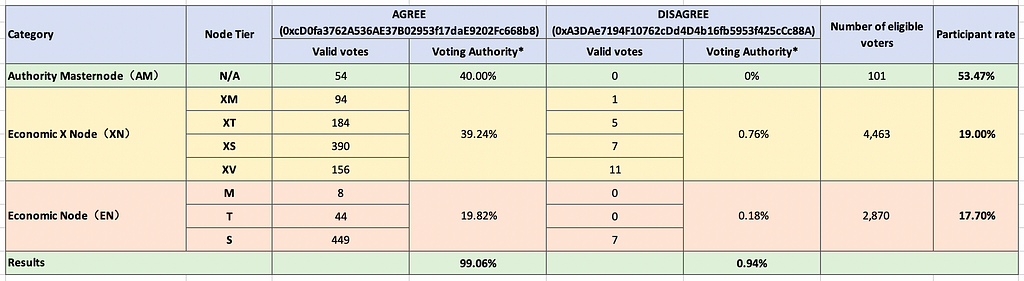
In light of the voting rules, between block#4,677,898 to block #4,721,015, a total quantity of 1,410 votes were counted as valid. The breakdown of the votes is as follows: 99.06% of the voting authority agree in favour of the block list being implemented permanently, and 0.94% disagreed.

To illustrate, 53.47% of Authority Node holders participated in the ballot, casting 54 votes. 19.00% of Economic X Node holders participated in the ballot, casting 848 votes. 17.70% of Economic Node holders participated in the ballot, casting 508 votes. More details can be seen in the following table.

* Note: The voting results were calculated based on the rules set in Announcing VeChain All-stakeholders Voting Relating to the Recent Foundation Buyback Wallet Incident, and all the voting records are available for independent verification at VeChain Explorer.

With the results being final, we will release another update the VeChainThor blockchain core node program, and work with all the Authority Masternodes to update and implement the block list permanently in the coming weeks.With this, the 727 million VET involved in the theft will be permanently taken out of the circulatory supply, and considered as burnt.

首个所有相关权益者投票已于北京时间12月30日上午10:00结束。唯链始终致力于在民主治理和高效执行中维持有机且持久的平衡,本次投票无疑是一次成功的印证。

本次投票旨在向唯链治理模型中最重要的相关权益者 — — 唯链社区成员,征求意见。在回购地址被盗事件中,12月18日经唯链战略决策委员会表决通过后,超级权益节点暂时启动黑名单。关于是否将黑名单永久加入唯链区块链,战略决策委员会将最终决定权交给社区进行投票表决。

根据最终投票结果显示,社区决定将事件涉及的黑名单永久写入唯链雷神区块链底层共识。在此,唯链基金会向所有社区成员在投票过程中展示出的理性、文明,以及互相尊重的态度表示衷心感谢。

截至北京时间2019年12月30日早10:00,每类投票人参与率均超过15%,因此投票最终结果生效。

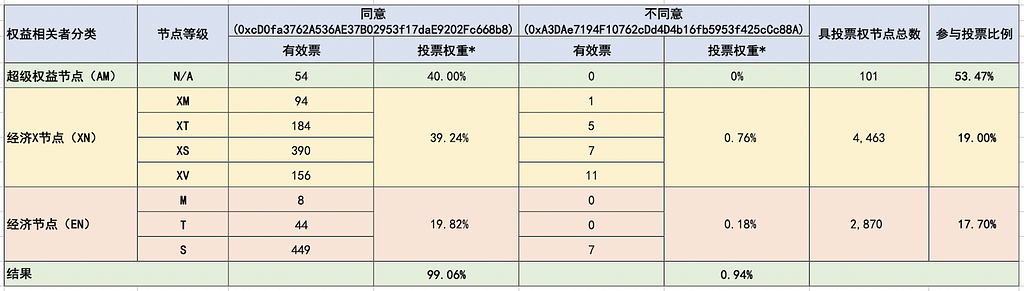
根据投票规则,在区块高度#4,677,898至#4,721,015之间,有效票共计有1410次,其中99.06%表示同意将黑名单永久写入唯链雷神区块链底层共识,0.94%表示拒绝。

据统计,超级权益节点持有者投票参与率为53.47%,产生有效投票54次。经济X节点持有者投票参与率为19%,产生有效投票848次。经济节点持有者投票参与率为17.7%,产生有效投票508次。详情见下表:

* 提示:本次投票计算方式参照此前公布的投票规则,并且所有数据皆在唯链官方浏览器上公开,可供审核验算。

本次投票的最终结果,将通过最新的节点程序写入唯链雷神区块链底层共识,并通过超级权益节点升级正式生效,7.27亿个VET将从总供应量和流通量中永远减去,被视为销毁


source https://www.tokentalk.co/VeChain/the-final-results-of-allstakeholders-voting-5e09f6b06acb1de95d0c2991

This analyst says there’s a “high chance” Bitcoin may never fall under $5k again @cryptoslate #Analysis #Price Watch

Once Bitcoin (BTC) started to incur strong losses in the second half of 2019, analysts were once again making extremely low price prediction...